From the teachings of Hazrat Maulana Shah Abdur Raheem Sahab Dard (Rahmatullah Alaih)
Meaning
Al-Mubdee means the Originator: the One who created all things for the first time, without any model or example.
Understanding the Name
Al-Mubdee began creation from nothing, and Al-Mueed will bring it back again. Allah says: “Indeed, it is He who originates (creation) and repeats it” (Al-Buruj 85:13), and “It is He who begins creation and then repeats it, and that is even easier for Him” (Ar-Rum 30:27).
Whoever reflects on how Allah first created him has no doubt that He can raise him again, and so he prepares for that meeting.
Effects and reflections
Allah began the creation of everything for the first time, from nothing. The One who created it can certainly bring His creatures back after their death; He has declared in the Qur’an that He will raise His creation on the Day of Reckoning, and that it will certainly happen, with ease.
He has told us about the reckoning on the Day of Resurrection, so we should prepare for the Hereafter while still in this world. This is how a person is inspired by the effect of this beautiful quality of Allah.
Treatment (Amal)
If “Yā Mubdi’” is recited 99 times before the Fajr adhan (for a pregnant woman), she will be protected, and will neither miscarry nor deliver prematurely, Insha’Allah.
From the teachings of Hazrat Maulana Shah Abdur Raheem Sahab Dard (Rahmatullah Alaih)
Meaning
Al-Muhsee means the Accounter, the Reckoner: the One who counts and records everything, with complete knowledge of its number and detail.
Understanding the Name
Nothing is too small or too many for Allah to count: every breath, every grain of sand, every deed. “He has encompassed whatever is with them and has counted all things in number” (Al-Jinn 72:28). Every soul will find its record complete on the Day of Judgement (Al-Kahf 18:49).
This Name teaches the believer to take account of himself before he is taken to account, as the Companions advised, and to value every small good deed, since none of it will be lost.
Effects and reflections
Innallaha bikulli shay’in ‘aleem, “Indeed, Allah has knowledge of all things.” The Creator is aware of His vast creation. He knows the account of our countless sins and the reality of all our good deeds.
Whoever is aware of this great Reckoner, fears Him and obeys Him deserves a high rank in this world and in the Hereafter.
Treatment (Amal)
Whoever recites “Yā Muḥṣī” 159 times after every prayer will, Insha’Allah, increase in knowledge and gain honour and dignity in society.
From the teachings of Hazrat Maulana Shah Abdur Raheem Sahab Dard (Rahmatullah Alaih)
Meaning
Al-Hameed means the Praiseworthy: the One who alone deserves all praise, glorification and thanks, whether or not anyone praises Him.
Understanding the Name
Every prayer begins with Alhamdulillahi Rabbil ‘alamin, “All praise is for Allah, Lord of the worlds.” Allah is praised for His perfect qualities and for His countless blessings. “O mankind, you are those in need of Allah, while Allah is the Free of need, the Praiseworthy” (Fatir 35:15).
A believer who remembers Al-Hameed learns to praise Allah in ease and in difficulty, and his heart becomes grateful and content.
Effects and reflections
Speaking about a good and capable person makes the speaker good as well, just as bad company has a harmful effect. So by remembering goodness a person becomes good, and by dwelling on evil he becomes evil.
Once Hazrat Rabi‘a Basri (Rahmatullah Alaiha) went out of her house for some need. To please her, her students began to talk about the evils of the world. When she returned she was displeased and said that instead they should have recited Durood (Salawat) and remembered Allah, as that would have been better for them. It is better to speak about goodness, because it influences the speaker.
Treatment (Amal)
Whoever recites “Yā Ḥamīd” 73 times after prayer, with Durood at the beginning and the end, will, Insha’Allah, be blessed with goodness.
From the teachings of Hazrat Maulana Shah Abdur Raheem Sahab Dard (Rahmatullah Alaih)
Meaning
Al-Waliyy means the Protecting Friend, the Patron: the One who befriends, supports and protects the righteous.
Understanding the Name
Wilayah means close friendship and protection. Allah is the Wali of the believers, and those who are close to Him are called His awliya: “Unquestionably, for the friends (awliya) of Allah there will be no fear concerning them, nor will they grieve” (Yunus 10:62).
The path of the mashaikh is the path of wilayah: through faith, taqwa and constant remembrance, a servant draws closer to his Lord until he becomes one of His friends.
“Allah is the Protecting Friend of those who believe; He brings them out of the darknesses into the light” (Al-Baqarah 2:257).
Allah is the Friend of the believers, and He brings His friends out of darkness. We too should regard iman as divine light and move towards Allah. We should keep our friendship with Allah above our friendship with His creatures. Allah is the Wali of the servant who has faith in Him, and He never disappoints His friends. The Muslim, too, should never disappoint his Creator.
Treatment (Amal)
A man whose wife has fallen into bad conduct should recite “Yā Waliyy” 57 times after every prayer; Insha’Allah, she will soon be reformed.
From the teachings of Hazrat Maulana Shah Abdur Raheem Sahab Dard (Rahmatullah Alaih)
Meaning
Al-Mateen means the Firm, the Steadfast: the One whose strength is unshakeable and never diminishes.
Understanding the Name
While Al-Qawiy describes the perfection of Allah’s strength, Al-Mateen describes its firmness and endurance: nothing can shake it or wear it down. The two Names come together in the verse: “Indeed, it is Allah who is the Provider, the Possessor of strength, the Firm” (Adh-Dhariyat 51:58).
Remembering Al-Mateen gives the believer steadfastness in faith, firmness in his principles and patience on the path, even when circumstances are hard.
Effects and reflections
The effect of this quality of Allah is that His servant himself becomes firm in character and influences others as well, by giving up insincerity and adopting seriousness and sincerity. Firmness belongs with truth, and insincerity with falsehood, so both cannot live in the same person.
As the Qur’an says, “Truth has come and falsehood has vanished.” Firmness, seriousness, devotion and dignity are found only in a steadfast person. This quality of Allah is reflected in His Messengers, the righteous and the pious.
Treatment (Amal)
Every Muslim who adopts firmness and asks Allah for it will be victorious over his enemies and opponents. It should be recited 511 times after every prayer.
From the teachings of Hazrat Maulana Shah Abdur Raheem Sahab Dard (Rahmatullah Alaih)
Meaning
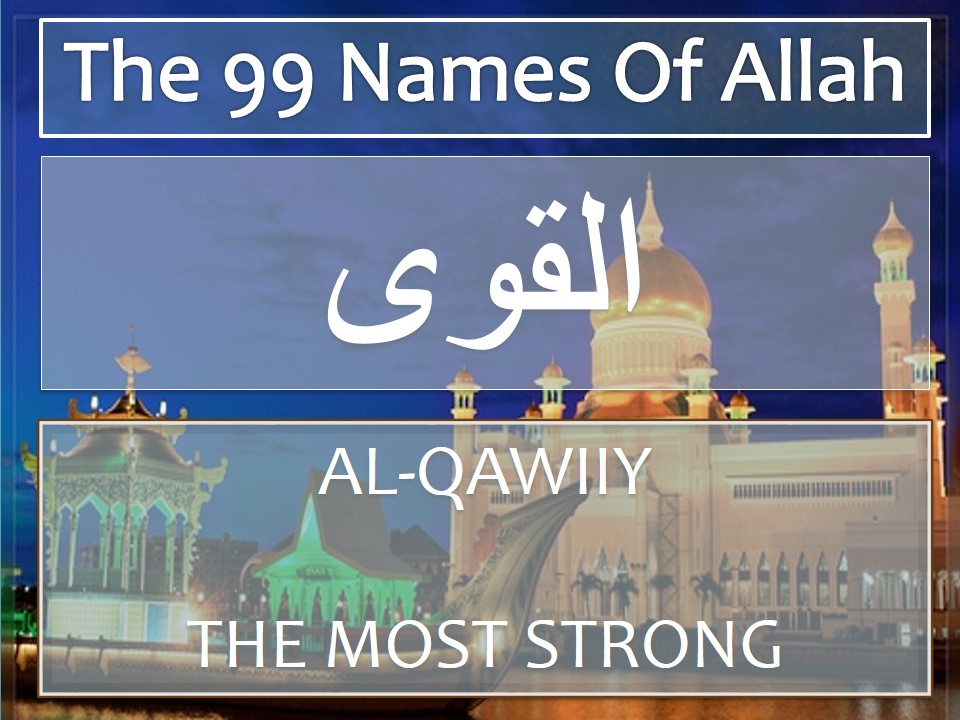
Al-Qawiy means the All-Strong, the Most Powerful: the One whose strength is perfect, never weakens and never tires.
Understanding the Name
Human strength rises and falls; Allah’s strength is complete and constant. “Indeed, Allah is Powerful and Exalted in Might” (Al-Hajj 22:40). The phrase La hawla wa la quwwata illa billah, “There is no power and no strength except with Allah”, which the Prophet ﷺ called a treasure of Paradise, expresses the meaning of this Name.
Relying on Al-Qawiy gives the weak courage and keeps the strong humble, because both know where all strength comes from.
Effects and reflections
We are weak, full of faults and limitations. If we recognise that Allah alone is Qawiy, we will not depend on others like ourselves, who are also weak, limited and imperfect. Instead, we will rely on and trust the Most Powerful, Allah, who is able to do everything.
Treatment (Amal)
One who is weak and oppressed should recite “Yā Qawiyy” 127 times after every prayer; Insha’Allah, his wish will be fulfilled.
From the teachings of Hazrat Maulana Shah Abdur Raheem Sahab Dard (Rahmatullah Alaih)
Meaning
Al-Wakeel means the Trustee, the Disposer of Affairs: the One to whom matters are entrusted, and who handles them in the best possible way.
Understanding the Name
A wakil is someone you trust to take care of your affairs. People choose human trustees who can fail, forget or betray; Allah is the perfect Trustee. The believers said: Hasbunallahu wa ni‘mal wakil, “Allah is sufficient for us, and He is the best Disposer of affairs” (Al ‘Imran 3:173). These were also the words of the Prophet Ibrahim when he was thrown into the fire.
Tawakkul (trust in Allah) means doing what we can, then leaving the result to Al-Wakeel with a calm heart. The Prophet ﷺ said: “Tie your camel, then trust in Allah.”
Effects and reflections
Everyone longs for a trustee, but ignorant people have made things such as the sun, the moon and rivers their trustees. If a person understood the true meaning of Wakeel, he would give up such ignorance.
One should accept Allah as one’s Trustee, hand over all one’s affairs to Him and let go of all worries. This brings happiness in this world and in the Hereafter.
Treatment (Amal)
We should hand over all our difficult tasks, and our own selves, to the Supreme Creator, and call upon Him by this Name. Insha’Allah, we will gain contentment and peace, and our tasks will be completed easily.
From the teachings of Hazrat Maulana Shah Abdur Raheem Sahab Dard (Rahmatullah Alaih)
Meaning
Al-Haqq means the Truth, the Real: the One whose existence is certain and unchanging, and who is the source of all truth.
Understanding the Name
Everything else exists because Allah gave it existence, and everything else will change and pass away; only Al-Haqq is real in the fullest sense. “That is because Allah is the Truth, and what they call upon besides Him is falsehood” (Luqman 31:30). His word is true, His promise is true, and the meeting with Him is true.
The seeker who remembers Al-Haqq loves truthfulness, stands with the truth even when it is difficult, and does not attach his heart to things that will vanish.
“And say: Truth has come and falsehood has vanished. Indeed, falsehood is bound to vanish” (Al-Isra’ 17:81).
The Qur’an teaches that when the truth comes, falsehood disappears. Allah has given us the ability to examine and recognise the truth and to accept it; whether we accept it depends on our intention, which is connected with the inner self, the nafs. Those who control their nafs submit to the truth and succeed in this life and the Hereafter.
Truth is a practical struggle and a spiritual renewal that makes a person complete and takes him to the heights of salvation.
Treatment (Amal)
A person whose family member is missing, or who has lost a belonging, should write this beautiful Name on all four corners of a square piece of paper. Before the adhan of Fajr, he should place it on his palms, raise his hands and make dua. Insha’Allah, he will succeed in finding what was lost.
Write
Yā Ḥaqq on the four corners of a square paper
When
Before the Fajr adhan
How
Hold it on your palms, raise your hands and make dua
From the teachings of Hazrat Maulana Shah Abdur Raheem Sahab Dard (Rahmatullah Alaih)
Meaning
Ash-Shaheed means the Witness, the Ever-Present: the One who observes everything and is a witness over all things.
Understanding the Name
Allah is present with His knowledge everywhere and witnesses every act, word and intention. “And Allah is, over all things, a Witness” (Al-Ahzab 33:55). On the Day of Judgement He will be the witness of every deed, and no denial will help anyone.
A person who knows that Ash-Shaheed is watching becomes truthful in his testimony and honest in his dealings, and he feels comforted when others misunderstand him, because his Witness knows the truth.
Effects and reflections
The highest level of love is reached by the martyr (shaheed), who gives his very life. There are three ways of practising love: to admire true beauty; to adorn one’s character, influencing others by one’s virtues and so beautifying both oneself and others; and to spread love and become lovable by developing good qualities, so that love becomes complete and perfect, without any gaps.
Good character stands between the witness and the truth.
Treatment (Amal)
One should regard Allah as ever-present and recite “Yā Shahīd” abundantly; Insha’Allah, great virtue will grow in him. Whoever recites it 300 times after every prayer will, Insha’Allah, be raised in rank by Allah.
Recite
Yā Shahīd, 300 times
When
After every prayer (and abundantly at other times)
From the teachings of Hazrat Maulana Shah Abdur Raheem Sahab Dard (Rahmatullah Alaih)
Meaning
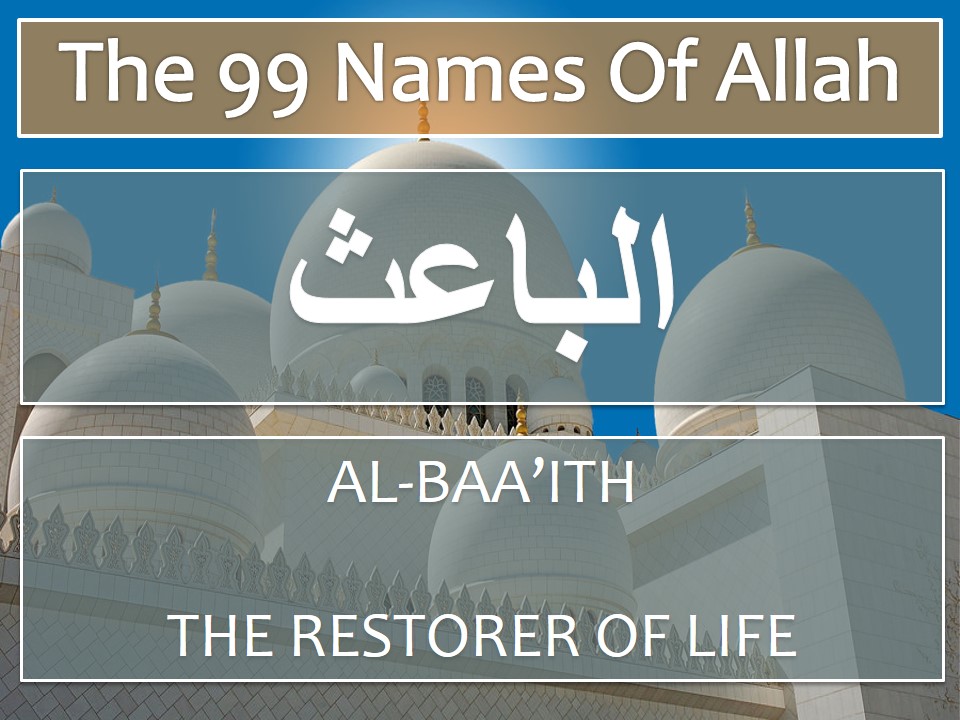
Al-Baaith means the Resurrector, the One who sends forth: He will raise the dead on the Day of Judgement, and it is He who sent the Messengers.
Understanding the Name
The root b-‘-th means to raise up and to send. Allah will bring every person back to life: “And that Allah will resurrect those in the graves” (Al-Hajj 22:7). He also “sent” the Prophets to bring dead hearts back to life with guidance. Belief in the Resurrection, al-ba‘thu ba‘dal mawt, is part of Iman-e-Mufassal.
Remembering this Name awakens the heart from heedlessness. It reminds the believer that this life is short and that he will stand before his Lord, so he prepares while there is still time.
Effects and reflections
Allah is the One who gives life and death, and He will raise the dead on the Day of Reckoning.
He tells us that He has done many favours for mankind and jinn, and that the greatest of them is that He sent the final Messenger, the Prophet Muhammad ﷺ. No messenger will come after him, but the doors of truth, piety and righteousness remain open.
Allah says in the Qur’an, in verses of Surah Al-Jumu‘ah and Surah Al ‘Imran, that He sent His Messenger to recite His verses to people, to purify them and to teach them the Book and wisdom, although before that they were in clear error (Al-Jumu‘ah 62:2; Al ‘Imran 3:164). Iman-e-Mufassal ends with wal-ba‘thi ba‘dal mawt, “and in being raised after death.” Before Islam, mankind was like the dead; through Islam and iman they were brought back to life.
The word Ba‘ith therefore has a deep meaning. Many servants of Allah neglect it, though remembering it is extremely beneficial for them.
Treatment (Amal)
To revive the heart with knowledge and wisdom, recite “Yā Bā‘ith” 584 times after every prayer, and recite it abundantly and sincerely before sleeping.




Jan 6 2015
Ya Mubdi Meaning, Benefits & Wazifa – Al-Mubdi (The Originator)
Al-Mubdi
From the teachings of Hazrat Maulana Shah Abdur Raheem Sahab Dard (Rahmatullah Alaih)
Meaning
Al-Mubdee means the Originator: the One who created all things for the first time, without any model or example.
Understanding the Name
Al-Mubdee began creation from nothing, and Al-Mueed will bring it back again. Allah says: “Indeed, it is He who originates (creation) and repeats it” (Al-Buruj 85:13), and “It is He who begins creation and then repeats it, and that is even easier for Him” (Ar-Rum 30:27).
Whoever reflects on how Allah first created him has no doubt that He can raise him again, and so he prepares for that meeting.
Effects and reflections
Allah began the creation of everything for the first time, from nothing. The One who created it can certainly bring His creatures back after their death; He has declared in the Qur’an that He will raise His creation on the Day of Reckoning, and that it will certainly happen, with ease.
He has told us about the reckoning on the Day of Resurrection, so we should prepare for the Hereafter while still in this world. This is how a person is inspired by the effect of this beautiful quality of Allah.
Treatment (Amal)
If “Yā Mubdi’” is recited 99 times before the Fajr adhan (for a pregnant woman), she will be protected, and will neither miscarry nor deliver prematurely, Insha’Allah.
By silsilaekamaliya • 99 Names of Allah – Meaning, Benefits & Wazifa • Tags: 99 Names of Allah, Ya-Mubdee