Allah has the most beautiful names, so call upon Him by them (Al-A‘raf 7:180). This collection explains each of the 99 Names of Allah (Asma ul Husna): its Arabic, its meaning, and the spiritual treatment (wazifa) taught by Hazrat Shah Abdur Raheem Sahab Dard (RA).
Each page gives the correct pronunciation (Ya Latif, Ya Razzaq, Ya Haqq…), the abjad value, how to recite it and for what need, together with bayanaat on the Names by Maulana Fazlur Rahman Mahmood Sahab.
اللہ تعالیٰ کے ننانوے نام (اسماءِ حسنیٰ): ہر نام کا معنی، فوائد، وظیفہ اور پڑھنے کا طریقہ۔
From the teachings of Hazrat Maulana Shah Abdur Raheem Sahab Dard (Rahmatullah Alaih)
Meaning
Al-Fattah means the Opener, the Judge: the One who opens the doors of mercy and provision, removes difficulties and solves every problem.
Understanding the Name
The root f-t-ḥ means to open. Al-Fattah opens what is closed: hearts to guidance, doors of provision, paths out of hardship, and victory after struggle. He also “opens” the truth between people by judging fairly. The Qur’an says: “And He is the Opener, the All-Knowing” (Saba’ 34:26). The opening chapter of the Qur’an is itself called Al-Fatiha.
When every door seems shut, the believer remembers that the keys of all things are with Allah, and turns to Al-Fattah with hope.
Effects and reflections
Seeking help from anyone other than Allah is shirk (associating partners with Him). Relief is not possible unless a person regrets and seeks forgiveness for falling into shirk, and accepts and follows Tawheed (the Oneness of Allah).
The recitation of this Name bears fruit only when the person stays completely away from shirk, seeks the help of the One and Only Almighty Allah, and follows the Prophet ﷺ.
Treatment (Amal)
Whoever recites “Yā Fattāḥ” 500 times after the Fajr prayer, with his hands placed on his chest, will, Insha’Allah, have his heart illuminated with the light (noor) of iman.
From the teachings of Hazrat Maulana Shah Abdur Raheem Sahab Dard (Rahmatullah Alaih)
Meaning
Ar-Razzaq means the Provider, the Sustainer: the One who provides everything His creatures need, for body and soul.
Understanding the Name
Rizq (provision) is not only money and food; it includes health, knowledge, faith, family and peace of mind. Allah says: “Indeed, it is Allah who is the Provider, the Possessor of strength, the Firm” (Adh-Dhariyat 51:58), and “There is no creature on earth but that its provision is upon Allah” (Hud 11:6).
Trusting Ar-Razzaq does not mean giving up effort; it means working honestly while knowing that the result comes from Him. Such trust removes greed and anxiety, and makes a person generous, because he knows his provision cannot be taken by anyone else.
Effects and reflections
Everyone, from a beggar to an emperor, shows the effects of the Provider. Allah alone has provided, provides and will always provide for us. The majesty of the Lord is clear from nature and from His countless creatures.
Those who are proud of their own knowledge become deprived of giving and charity. Those who understand the secret of Ar-Razzaq never run after provision; instead, provision reaches them by the command of Allah.
Treatment (Amal)
Whoever recites “Yā Razzāq” 319 times after every prayer, with Durood at the beginning and the end, will, by Allah’s will, be granted provision.
From the teachings of Hazrat Maulana Shah Abdur Raheem Sahab Dard (Rahmatullah Alaih)
Meaning
Al-Wahhab means the Bestower, the Giver of Gifts: the One who gives freely and abundantly, without asking anything in return.
Understanding the Name
A gift (hibah) is something given out of pure generosity, not as payment. Al-Wahhab gives constantly, to those who ask and to those who do not. The Prophet Sulayman (Solomon) prayed with this Name: “My Lord, forgive me and grant me a kingdom such as will not belong to anyone after me; indeed, You are the Bestower” (Sad 38:35), and the believers pray: “Grant us mercy from Yourself; indeed, You are the Bestower” (Al ‘Imran 3:8).
Recognising that every gift comes from Al-Wahhab builds a deep relationship with Him and frees the heart from depending on people.
Effects and reflections
Al-Wahhab fulfils the needs and wishes of those in need; believing this creates a deep bond with Allah. He is a Giver who is never annoyed by the requests of the needy; rather, He is pleased when they ask sincerely and from the heart. Allah loves those servants who ask Him again and again and seek His blessings.
Treatment (Amal)
To be freed from poverty, recite “Yā Wahhāb” 25 times after every prayer, or write it and keep it with you. If Allah wills, the poverty will be removed.
From the teachings of Hazrat Maulana Shah Abdur Raheem Sahab Dard (Rahmatullah Alaih)
Meaning
Al-Qahhar means the Subduer, the Ever-Dominant: the One who has complete control over all things, and before whom every power bows.
Understanding the Name
The root q-h-r means to overpower and subdue. Every tyrant, every proud soul and every force in nature is under the control of Al-Qahhar. The Qur’an joins this Name with Al-Wahid, the One: “Say: Allah is the Creator of all things, and He is the One, the Prevailing” (Ar-Ra‘d 13:16). On the Day of Judgement it will be asked, “To whom belongs the kingdom this Day?” and the answer will be, “To Allah, the One, the Prevailing” (Ghafir 40:16).
For the spiritual seeker, this Name is a means of subduing his own nafs (lower self) and its desires, which is the greatest struggle of all.
Effects and reflections
A person receives either the anger of Allah or His blessings, depending on his deeds. One accepts Allah as Al-Qahhar by keeping control over his own anger. By obeying Allah and His Messenger ﷺ, one can avoid the anger of Allah.
Treatment (Amal)
Reciting “Yā Qahhār” wholeheartedly is very beneficial for freeing the soul from worldly desires and for increasing love of Allah and His Messenger ﷺ.
Recite
Yā Qahhār, wholeheartedly
Benefit
Freedom from worldly desires; love of Allah and His Messenger ﷺ
From the teachings of Hazrat Maulana Shah Abdur Raheem Sahab Dard (Rahmatullah Alaih)
Meaning
Al-Ghaffar means the Ever-Forgiving: the One who forgives again and again, however often His servants return to Him.
Understanding the Name
The root gh-f-r means to cover and to protect, like a helmet (mighfar) that covers the head. Al-Ghaffar covers our sins, hides them from others and shields us from their consequences. The form ghaffar stresses repetition: His forgiveness is not given once only, but every time we sincerely repent. The Prophet Nuh (Noah) told his people: “Ask forgiveness of your Lord; indeed, He is ever Forgiving” (Nuh 71:10).
No one should despair because of the number of his sins. The door of Al-Ghaffar stays open until the last breath, and every sincere return is welcomed.
Effects and reflections
We should develop within ourselves the qualities of forgiveness, of overlooking others’ mistakes and of hiding their small faults. This removes mutual differences between people. Avoiding a quarrel is better than taking part in it.
Treatment (Amal)
A person who recites “Yā Ghaffār” 1,392 times after the Jumu‘ah prayer, and 100 times daily after the Asr prayer, will have his sins forgiven, Insha’Allah.
From the teachings of Hazrat Maulana Shah Abdur Raheem Sahab Dard (Rahmatullah Alaih)
Meaning
Al-Musawwir means the Fashioner, the Shaper of Forms: the One who gives every creature its unique shape and appearance.
Understanding the Name
The root s-w-r means form and image. Al-Musawwir gives each being its own face, colour and form, so that no two are exactly alike. Allah says: “It is He who shapes you in the wombs however He wills” (Al ‘Imran 3:6), and “He formed you and perfected your forms” (Ghafir 40:64).
Looking at the endless variety of faces, flowers and creatures, the believer praises the Fashioner. Remembering this Name also teaches contentment with how Allah has made us, and gratitude for the beauty in His creation.
Treatment (Amal)
A woman who fasts for seven days, breaks her fast with a drink of water, and recites “Yā Musawwir” 347 times will, by Allah’s will, be blessed with a son.
From the teachings of Hazrat Maulana Shah Abdur Raheem Sahab Dard (Rahmatullah Alaih)
Meaning
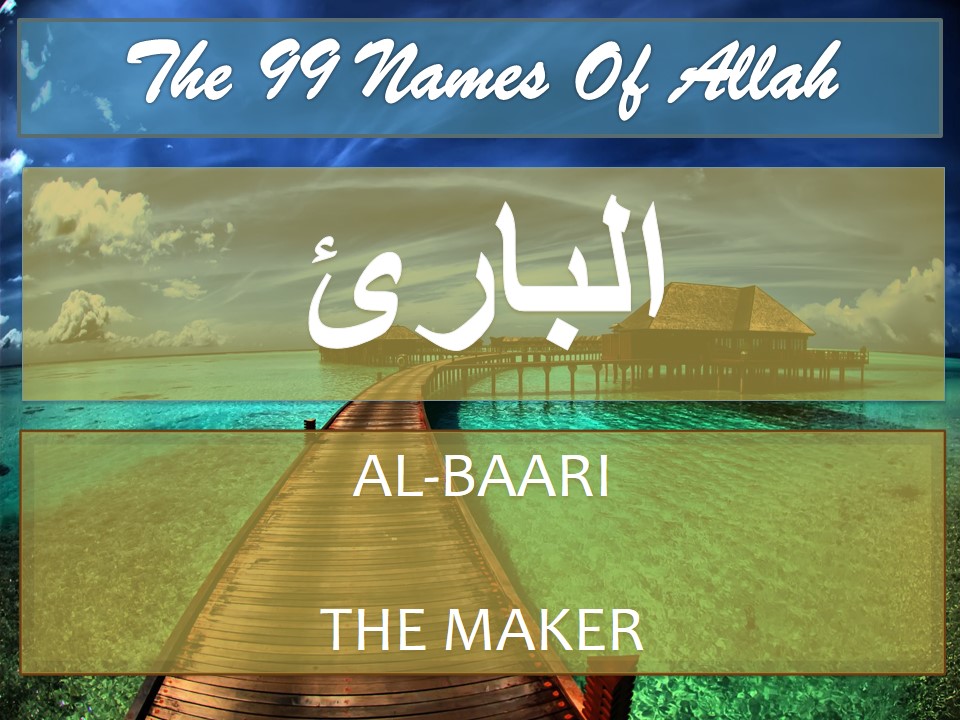
Al-Baari means the Maker, the Originator: the One who brings creation into being, distinct and free of flaws, and makes each thing fit for its purpose.
Understanding the Name
While Al-Khaliq refers to planning and measuring creation, Al-Baari refers to bringing it into actual existence, separate and distinct from everything else, without any defect. The Name appears in Al-Hashr 59:24 between Al-Khaliq and Al-Musawwir, and the Prophet Musa (Moses) told his people to repent “to your Maker (Bari’ikum)” (Al-Baqarah 2:54).
A believer who reflects on Al-Baari understands that he was made deliberately and lovingly, and that his true worth lies in fulfilling the purpose for which he was made.
Treatment (Amal)
A woman who wishes to have a child but has not been able to should fast for seven days, and each day after iftar recite this Name 224 times, with Durood Shareef at the beginning and the end. Insha’Allah, Allah will bless her with a son.
From the teachings of Hazrat Maulana Shah Abdur Raheem Sahab Dard (Rahmatullah Alaih)
Meaning
Al-Khaliq means the Creator: the One who brings everything into existence from nothing, according to a perfect plan and measure.
Understanding the Name
The root kh-l-q means to create and to measure out. Al-Khaliq decides what will exist, in what form, and at what time. The Qur’an says: “Allah is the Creator of all things, and He is the Guardian over all things” (Az-Zumar 39:62). Together with Al-Bari and Al-Musawwir, this Name describes the stages of creation (Al-Hashr 59:24).
Every person, every leaf and every star is a sign pointing to its Creator. Reflecting on Al-Khaliq removes arrogance from the heart: we did not create ourselves, and everything we have came from Him.
Effects and reflections
All creatures are the work of the Creator; each one was a secret in the knowledge of Allah and was brought into being at its appointed time.
If you ask an ‘arif (a Sufi who knows Allah) his name, he will reply, “I am a creature.” Ask him, “Whose creature?” and he will say, “The Creator’s.” Ask again, “Who is the Creator?” and he will answer, “The Creator of all creatures, the One and Unique: Allah.”
Treatment (Amal)
Whoever recites this Name 742 times daily for 7 days will be protected from all evils. Whoever recites it often will find his face becoming bright with light (noor).
From the teachings of Hazrat Maulana Shah Abdur Raheem Sahab Dard (Rahmatullah Alaih)
Meaning
Al-Mutakabbir means the Supreme in Greatness, the Majestic: the One to whom all true greatness belongs, and who is far above every creature.
Understanding the Name
Pride (kibr) is blameworthy in people, because they have nothing that was not given to them. In Allah, greatness is simply the truth: all greatness is His by right. In a Hadith Qudsi Allah says that grandeur (kibriya’) is His cloak and greatness (‘azamah) His garment, and whoever competes with Him in either will be punished. The Name is mentioned in Al-Hashr 59:23.
Knowing Al-Mutakabbir humbles the believer. The more he recognises the greatness of his Lord, the more he lowers himself before Him, and the more Allah raises him in honour.
Treatment (Amal)
Whoever recites “Yā Mutakabbir” 173 times morning and evening will be blessed by Allah with respect and honour, and will be successful in his affairs.
From the teachings of Hazrat Maulana Shah Abdur Raheem Sahab Dard (Rahmatullah Alaih)
Meaning
Al-Jabbar means the Compeller and the Restorer: the All-Powerful and Supreme, who also mends what is broken and comforts the broken-hearted.
Understanding the Name
The root j-b-r has two beautiful meanings. One is power and compelling force: nothing happens against Allah’s will. The other is mending, as when a broken bone is set (jabira). So Al-Jabbar is the Supreme One who also heals hearts, restores what was lost and lifts up those who are crushed. The Name is mentioned in Al-Hashr 59:23.
Between the two prostrations of prayer the Prophet ﷺ would ask Allah: wajburni, “mend me”. Whoever feels broken by loss, failure or oppression can turn to Al-Jabbar, who is able to repair what no one else can.
Treatment (Amal)
Reciting “Yā Jabbār” 217 times every morning and evening will, by Allah’s will, protect the reciter from his enemies.




Jan 5 2015
Ya Fattah Meaning, Benefits & Wazifa – Al-Fattah (The Opener)
Al-Fattah
From the teachings of Hazrat Maulana Shah Abdur Raheem Sahab Dard (Rahmatullah Alaih)
Meaning
Al-Fattah means the Opener, the Judge: the One who opens the doors of mercy and provision, removes difficulties and solves every problem.
Understanding the Name
The root f-t-ḥ means to open. Al-Fattah opens what is closed: hearts to guidance, doors of provision, paths out of hardship, and victory after struggle. He also “opens” the truth between people by judging fairly. The Qur’an says: “And He is the Opener, the All-Knowing” (Saba’ 34:26). The opening chapter of the Qur’an is itself called Al-Fatiha.
When every door seems shut, the believer remembers that the keys of all things are with Allah, and turns to Al-Fattah with hope.
Effects and reflections
Seeking help from anyone other than Allah is shirk (associating partners with Him). Relief is not possible unless a person regrets and seeks forgiveness for falling into shirk, and accepts and follows Tawheed (the Oneness of Allah).
The recitation of this Name bears fruit only when the person stays completely away from shirk, seeks the help of the One and Only Almighty Allah, and follows the Prophet ﷺ.
Treatment (Amal)
Whoever recites “Yā Fattāḥ” 500 times after the Fajr prayer, with his hands placed on his chest, will, Insha’Allah, have his heart illuminated with the light (noor) of iman.
By silsilaekamaliya • 99 Names of Allah – Meaning, Benefits & Wazifa • Tags: 99 Names of Allah, Ya-Fattaah