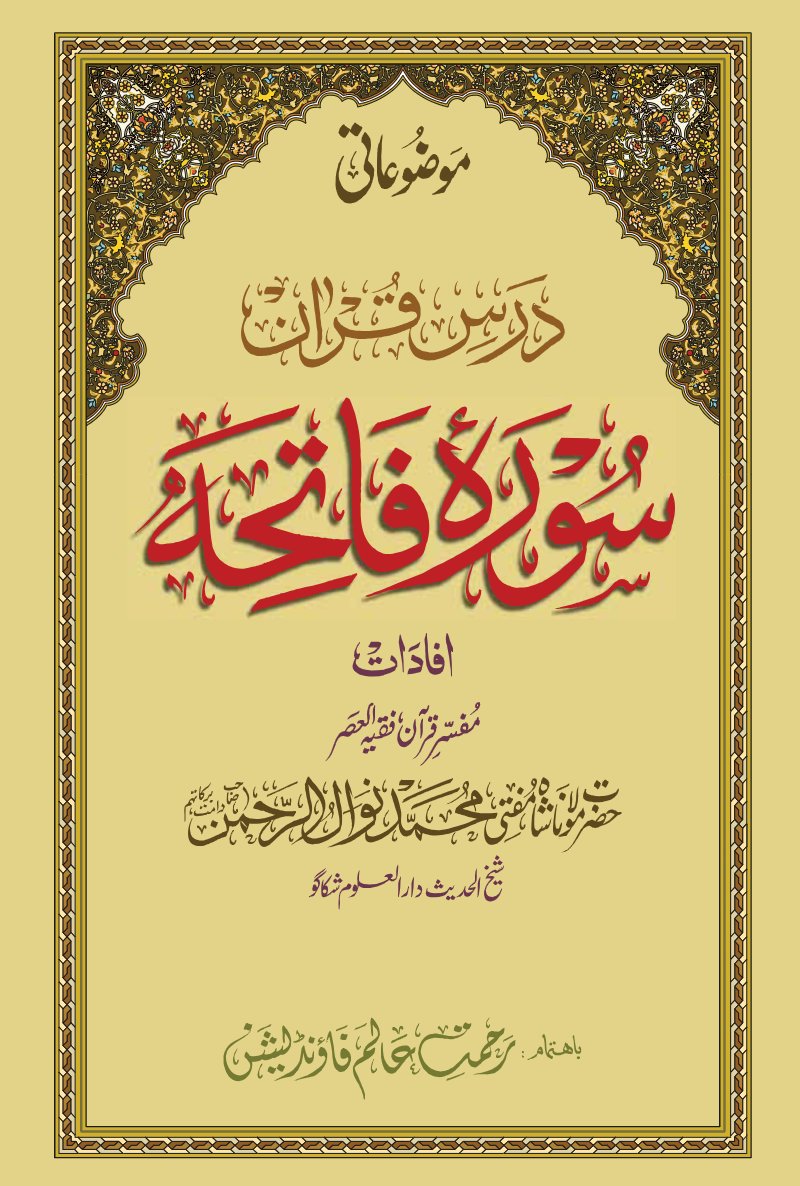
Surah Al-Fatiha is the opening of the Qur’an and the heart of every rak‘ah of salah. This 318-page Urdu book, Mauzuati Dars e Quran – Surah Fatiha, presents the thematic dars of Hazrat Maulana Shah Mufti Mohammed Nawal ur Rahman Sahab on this great surah.
Before the tafseer itself, the book gives a valuable introduction to Uloom ul Quran: what wahy (revelation) is and why mankind needs it, the sources of knowledge, the ways revelation came to the Prophet ﷺ, the belief of Ahl us Sunnah about the Kalam of Allah, the history of the revelation of the Qur’an, Makki and Madani surahs, the wisdom of gradual revelation and asbab un nuzul.
It then explains each verse of Al-Fatiha: praise of Allah, His lordship of the worlds, His mercy, the Day of Recompense, worship and seeking help from Allah alone, and the du‘a for the straight path. It is an excellent book for anyone who wants their salah to come alive with understanding.
What you will find inside
What wahy (revelation) is and why we need it
Sources of knowledge and their limits
How revelation came to the Prophet ﷺ
The belief of Ahl us Sunnah about the Kalam of Allah
History of the revelation of the Qur’an
Makki and Madani surahs
The wisdom of gradual revelation
Verse-by-verse tafseer of Surah Al-Fatiha
Read online
If the book does not appear above (on some phones), tap Read online or download the PDF.
Frequently asked questions
What is in this Surah Fatiha tafseer?
An introduction to wahy and Uloom ul Quran, followed by a detailed thematic explanation of every verse of Surah Al-Fatiha in Urdu.
Can I download the Surah Fatiha tafseer PDF?
Yes, the full PDF is free to read online or download from this page.
Published by Shariah Board of America · Rahmat-e-Alam Foundation, Chicago. With thanks to the Shariah Board, where this book was first published online.
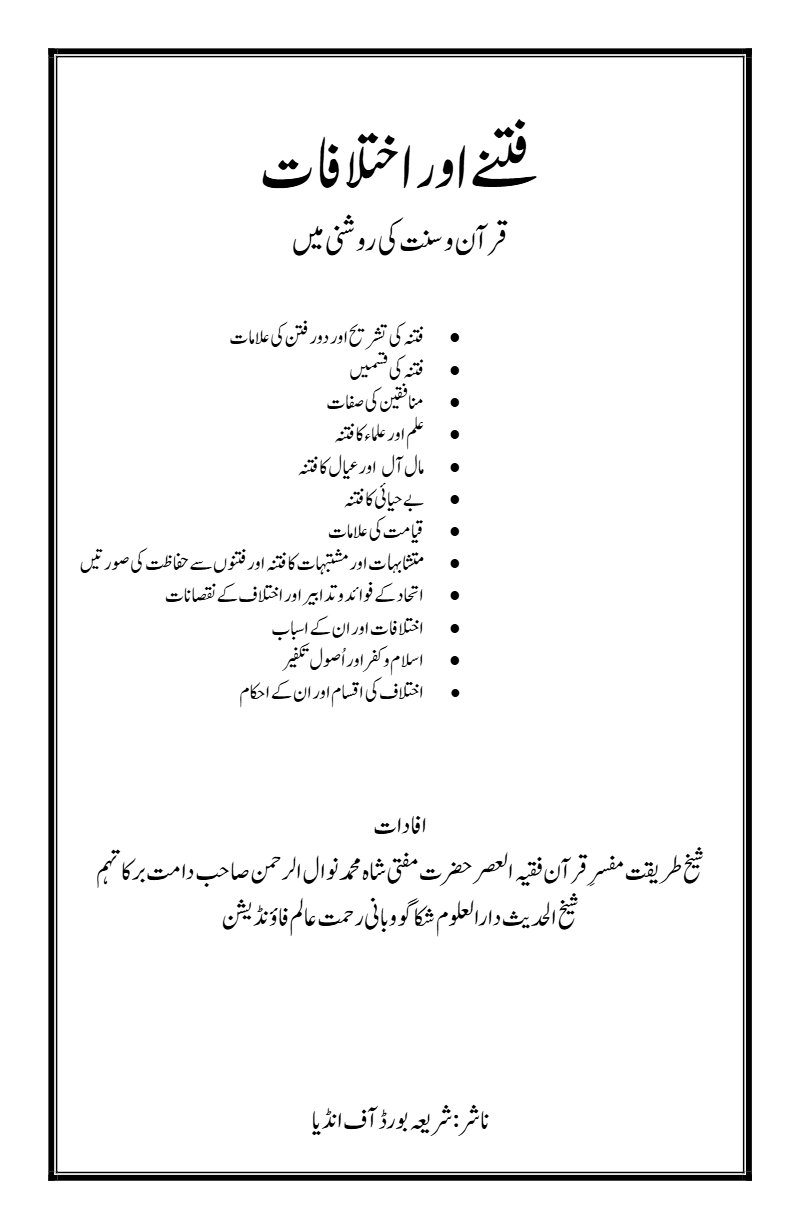
We live in an age of fitan, trials that test faith, and of ikhtilafat, disputes that divide families and communities. Fitne Aur Ikhtilafat – Quran o Sunnat Ki Roshni Mein is a 420-page Urdu work from the teachings of Hazrat Maulana Shah Mufti Mohammed Nawal ur Rahman Sahab that explains what the Qur’an and the ahadith say about both.
The first part explains the meaning of fitnah, its kinds and the signs of the times of trial foretold by the Prophet ﷺ: the fitnah of wealth, of women, of hypocrisy, of Dajjal and the major and minor signs of the Hour. It describes the qualities of the munafiqeen so that a believer can guard against them in himself.
The second part turns to disagreement: why ikhtilaf arises, which differences are acceptable and which are destructive, the principles of Islam for handling disputes, and the way to protect oneself and one’s family from fitan through iman, knowledge, patience and the company of the righteous.
What you will find inside
The meaning and kinds of fitnah
Signs of the times of fitan foretold in the ahadith
The qualities of the hypocrites (munafiqeen)
The fitnah of wealth, women and children
The fitnah of Dajjal and the signs of Qiyamah
How to protect yourself and your family from fitan
Causes and consequences of ikhtilaf
The principles of Islam for handling disagreement
Read online
If the book does not appear above (on some phones), tap Read online or download the PDF.
Frequently asked questions
What does “Fitne Aur Ikhtilafat” mean?
It means “Trials and Disagreements”. The book explains the trials (fitan) of the last times and the right way to deal with disputes, in the light of the Qur’an and Sunnah.
How can I protect myself from fitnah?
The book points to firm iman, knowledge of the deen, patience, du‘a, the company of the righteous and holding to the Qur’an and Sunnah.
Published by Shariah Board of India. With thanks to the Shariah Board, where this book was first published online.
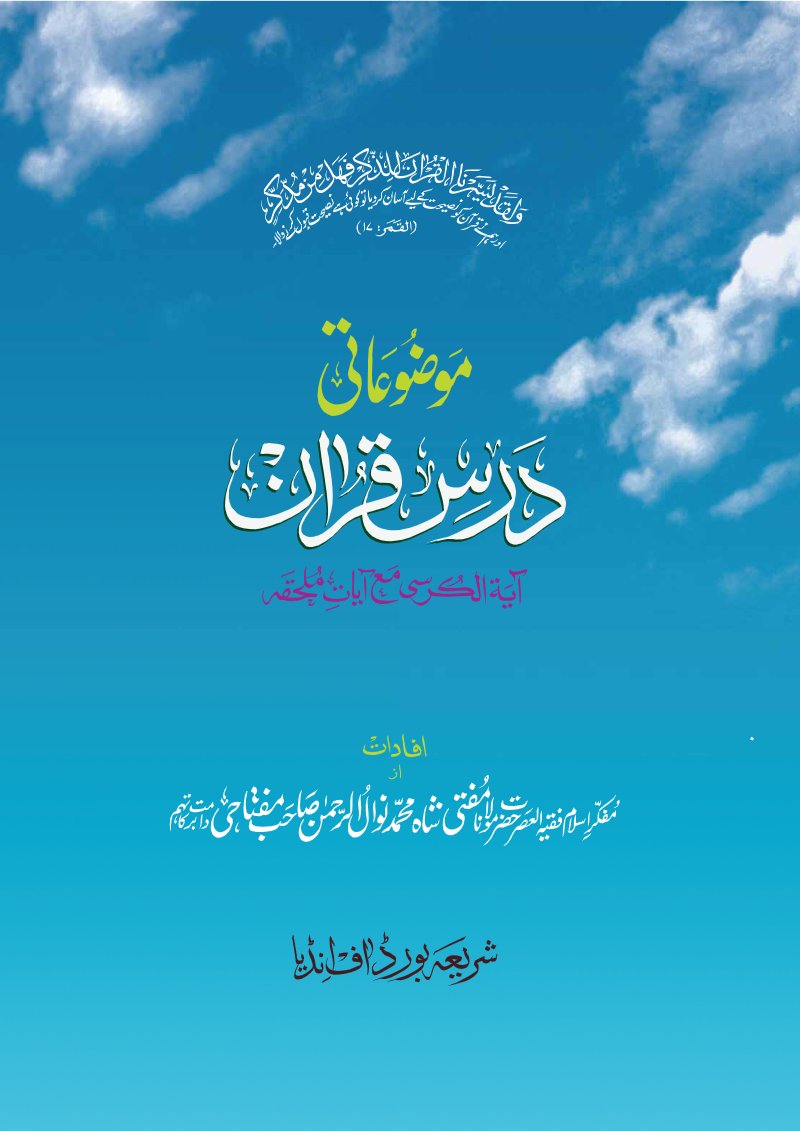
The Prophet ﷺ called Ayat ul Kursi the greatest verse of the Book of Allah. This book, Mauzuati Dars e Quran – Ayat ul Kursi, is a detailed thematic tafseer of the verse in Urdu, drawn from the dars of Hazrat Maulana Shah Mufti Mohammed Nawal ur Rahman Sahab, Shaykh ul Hadith of Darul Uloom Chicago.
Phrase by phrase, it explains what Ayat ul Kursi teaches about the oneness of Allah, His being Al-Hayy and Al-Qayyum, His perfect knowledge, His ownership of the heavens and the earth, and the reality of intercession on the Day of Judgement. Along the way it explains why Allah is free of drowsiness and sleep, and what the majesty of Allah described in this verse means for the believer.
Written in clear Urdu for ordinary readers, students and imams alike, it is ideal for anyone who recites Ayat ul Kursi daily and wants to understand its meaning and live by it.
What you will find inside
The purpose of the creation of man
Who alone is worthy of worship
Allah’s attribute of Qayyumiyyah (sustaining all things)
The Ism e Azam (the greatest Name of Allah)
The effect of Allah’s majesty on the angels
Why Allah is free of drowsiness and sleep
The owner of the heavens and the earth
The reality and purpose of shafa‘ah (intercession)
The majesty of Allah and its effect on the Prophets
The distinction of the ummah of Muhammad ﷺ
Read online
If the book does not appear above (on some phones), tap Read online or download the PDF.
Frequently asked questions
What is this book about?
It is a detailed Urdu tafseer of Ayat ul Kursi (Surah Al-Baqarah 2:255) and related verses, explaining tawheed, Allah’s attributes, His Kursi and the reality of intercession.
Is the Ayat ul Kursi tafseer PDF free?
Yes. You can read it online or download the full PDF free of charge from this page.
Published by Shariah Board of America · Rahmat-e-Alam Foundation, Chicago. With thanks to the Shariah Board, where this book was first published online.
Tafweez, handing over one’s affairs entirely to Allah, is a higher stage of tawakkul. In this bayan Hazrat Maulana Shah Fazlur Rahman Mahmood Sahab (DB) explains this station.
The believer of Pharaoh’s people said: “I entrust my affair to Allah.” Tafweez brings a peace that worries cannot touch.
Khashiyat e Ilahi is the awe-filled fear of Allah that comes from knowing Him: His greatness, His closeness and His justice. It is not the fear that drives a person away, but the fear that pulls him back from sin and towards his Lord. In this Friday khutba, Hazrat Maulana Shah Mohammed Jamal ur Rahman Sahab (DB) turns the attention of the listeners to this quality, which the Qur’an describes as the hallmark of those who truly know Allah.
When khashiyat settles in the heart, the eyes become humble, the tongue becomes careful and the hands stay away from what is forbidden. This khutba is a reminder that taqwa is not a slogan but a living state of the heart, nurtured by remembering Allah, reflecting on death and the Hereafter, and keeping the company of the righteous.
Key lessons
What khashiyat is, and how it differs from ordinary fear
Knowledge of Allah as the root of true fear
How fear of Allah protects a person in private and in public
Tears, repentance and humility as signs of a living heart
Humility (tawazu‘) is a great quality that beautifies the inner self. In this bayan Hazrat Maulana Shah Fazlur Rahman Mahmood Sahab (DB) explains humility among the stations of sulook.
The servants of the Most Merciful walk on the earth humbly. The Prophet ﷺ taught that whoever humbles himself for Allah, Allah raises him.
What is meant by the station of huzn (grief) on the path of sulook? Hazrat Maulana Shah Fazlur Rahman Mahmood Sahab (DB) explains this inner state in the context of tazkiya-e-nafs.
Praiseworthy grief is sorrow over one’s shortcomings and over time lost from Allah, a sorrow that drives the seeker forward rather than weakening him.
A faith-enriching and thought-provoking bayan on the station of hope (raja): who truly deserves the mercy of Allah? Hazrat Maulana Shah Fazlur Rahman Mahmood Sahab (DB) explains the difference between real hope and wishful thinking.
Allah forbids despair of His mercy. True hope is accompanied by effort, repentance and good deeds.
Part 2 of the thought-provoking bayan on khauf-e-ilahi by Hazrat Maulana Shah Fazlur Rahman Mahmood Sahab (DB).
This part continues to show how the fear of Allah transforms a person’s private life, his dealings and his worship, and how it is balanced with hope in His mercy.
The fear of Allah is the foundation of true iman and taqwa. In this bayan Hazrat Maulana Shah Fazlur Rahman Mahmood Sahab (DB) explains khauf-e-ilahi and how it protects the heart from sin.
The Qur’an promises Paradise to the one who feared standing before his Lord and restrained his self from desire.









Oct 18 2026
Surah Fatiha Tafseer in Urdu PDF – Mauzuati Dars e Quran | Mufti Nawal ur Rahman
Surah Al-Fatiha – Mauzuati Dars e Quran
About this book
Surah Al-Fatiha is the opening of the Qur’an and the heart of every rak‘ah of salah. This 318-page Urdu book, Mauzuati Dars e Quran – Surah Fatiha, presents the thematic dars of Hazrat Maulana Shah Mufti Mohammed Nawal ur Rahman Sahab on this great surah.
Before the tafseer itself, the book gives a valuable introduction to Uloom ul Quran: what wahy (revelation) is and why mankind needs it, the sources of knowledge, the ways revelation came to the Prophet ﷺ, the belief of Ahl us Sunnah about the Kalam of Allah, the history of the revelation of the Qur’an, Makki and Madani surahs, the wisdom of gradual revelation and asbab un nuzul.
It then explains each verse of Al-Fatiha: praise of Allah, His lordship of the worlds, His mercy, the Day of Recompense, worship and seeking help from Allah alone, and the du‘a for the straight path. It is an excellent book for anyone who wants their salah to come alive with understanding.
What you will find inside
Read online
Frequently asked questions
What is in this Surah Fatiha tafseer?
Can I download the Surah Fatiha tafseer PDF?
More books by Mufti Nawal ur Rahman Sahab
By silsilaekamaliya • Books - Mufti Nawal ur Rahman Sahab, Islamic Urdu Books – Silsila e Kamaliya • Tags: Dars e Quran, free islamic books, Mufti Nawal ur Rahman, Silsila e Kamaliya, Surah Fatiha, Surah Fatiha Tafseer, Tafseer in Urdu, Uloom ul Quran, Urdu Books PDF, Urdu Islamic Books PDF